Geometric Prime Conjecture
This page hosts the text of the conjecture, supporting images, and links to software that allows you to explore and test the ideas yourself.
The Martini Glass Conjecture (Part I)
Twin prime midpoints, expressed as integers, sit on a regular scaffold: every twin midpoint beyond 4 is a multiple of 6 (twin pairs lie at 6k ± 1, so the midpoint is 6k). The Martini Glass Conjecture proposes that this scaffold also governs the midpoints of ordinary prime pairs: away from a single structural boundary, every prime-pair midpoint carries a twin-midpoint factor, or else the gap does.
Around such a midpoint one can identify a group of four primes—here coined a Martini Prime group, with members denoted PPL, PPH, PTL and PTH—sharing a common geometric relationship across scales.
Computational tests support the statement at every scale tried: consecutive prime pairs to 10⁸, and all prime pairs (both members greater than 3) within tested windows, with worked Martini groups exhibited to thousands of digits.
Let (PPL, PPH) be a pair of primes with both members greater than 3, midpoint MP = (PPL + PPH)/2 and gap Δ = PPH − PPL. Then MP is divisible by at least one twin midpoint (MT), unless the gap Δ is itself a twin midpoint or a multiple of one.
Definitions
- Twin midpoint (MT)
- The midpoint of a twin prime pair (p, p+2); that is, p+1. The lower and higher twins are denoted PTL and PTH.
- Prime pair midpoint (MP)
- For a prime pair (PPL, PPH), the value (PPL + PPH)/2.
- Gap (Δ)
- PPH − PPL.
- Martini divisor (kMT)
- For a twin midpoint MT dividing MP, the integer kMT = MP / MT, so that MP = MT · kMT.
The single boundary of the conjecture is the prime 3. In every counterexample found over arbitrary prime pairs, 3 is a member of the pair; no pair with both members 5 or greater has been observed to fail, and pairs containing 2 do not fail either. The reason is structural: divisibility by a twin midpoint is governed by the mod-6 scaffold above, and 3 generates that scaffold rather than belonging to it (3 is not of the form 6k ± 1). Midpoints formed using 3 therefore fall outside the periodic structure the conjecture describes. The earlier consecutive-pair exceptions (2,3) and (2,5) are simply the only consecutive pairs that sit at this lower boundary.
Gaps below 6 are set aside for two distinct reasons, not one. A gap of 2 makes MP itself a twin midpoint, so the statement holds trivially and without content (the prime pair is the twin pair). A gap of 4 forces MP to be odd, and no twin midpoint (all even) can divide an odd number, so every gap-4 pair would falsify the statement; this is the genuine lower-boundary obstruction. A gap of 6 is mixed and is set aside with them.
The gap clause (“unless Δ is a twin midpoint or a multiple of one”) is the complementary case: when the gap already carries a twin-midpoint factor, the midpoint need not. Across consecutive pairs this clause accounts for roughly half of all cases, so it is part of the statement rather than a minor caveat.
Status: open conjecture. The mod-6 structure of twin midpoints suggests the member-3 boundary and the gap-4 obstruction may both be provable by an elementary residue argument; the divisibility claim itself remains unproven and is supported only by computation.
Downloadable PDF
📄 Download the Conjecture (PDF)
Supporting Images
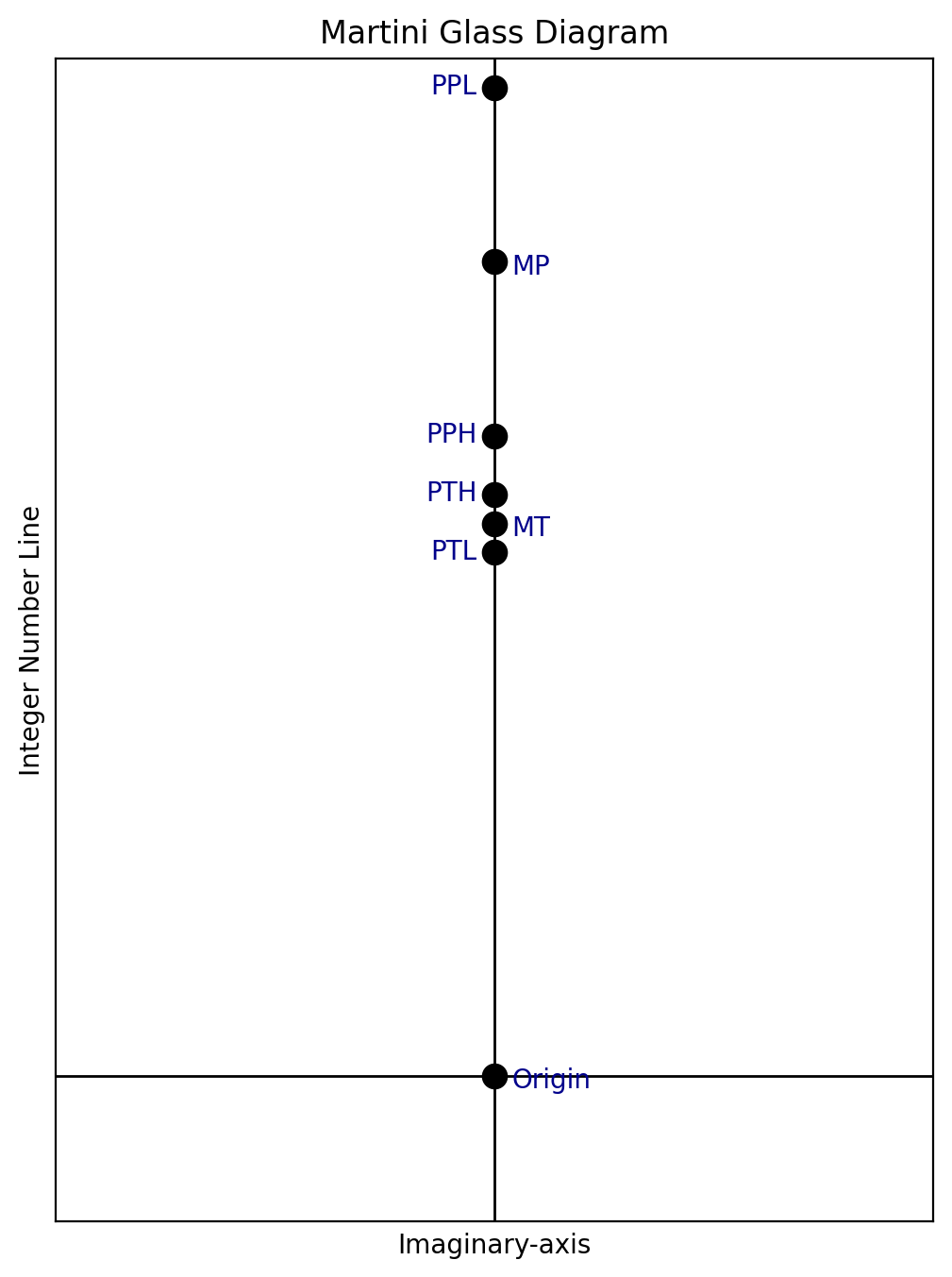
Martini Glass Diagram (Vertical)
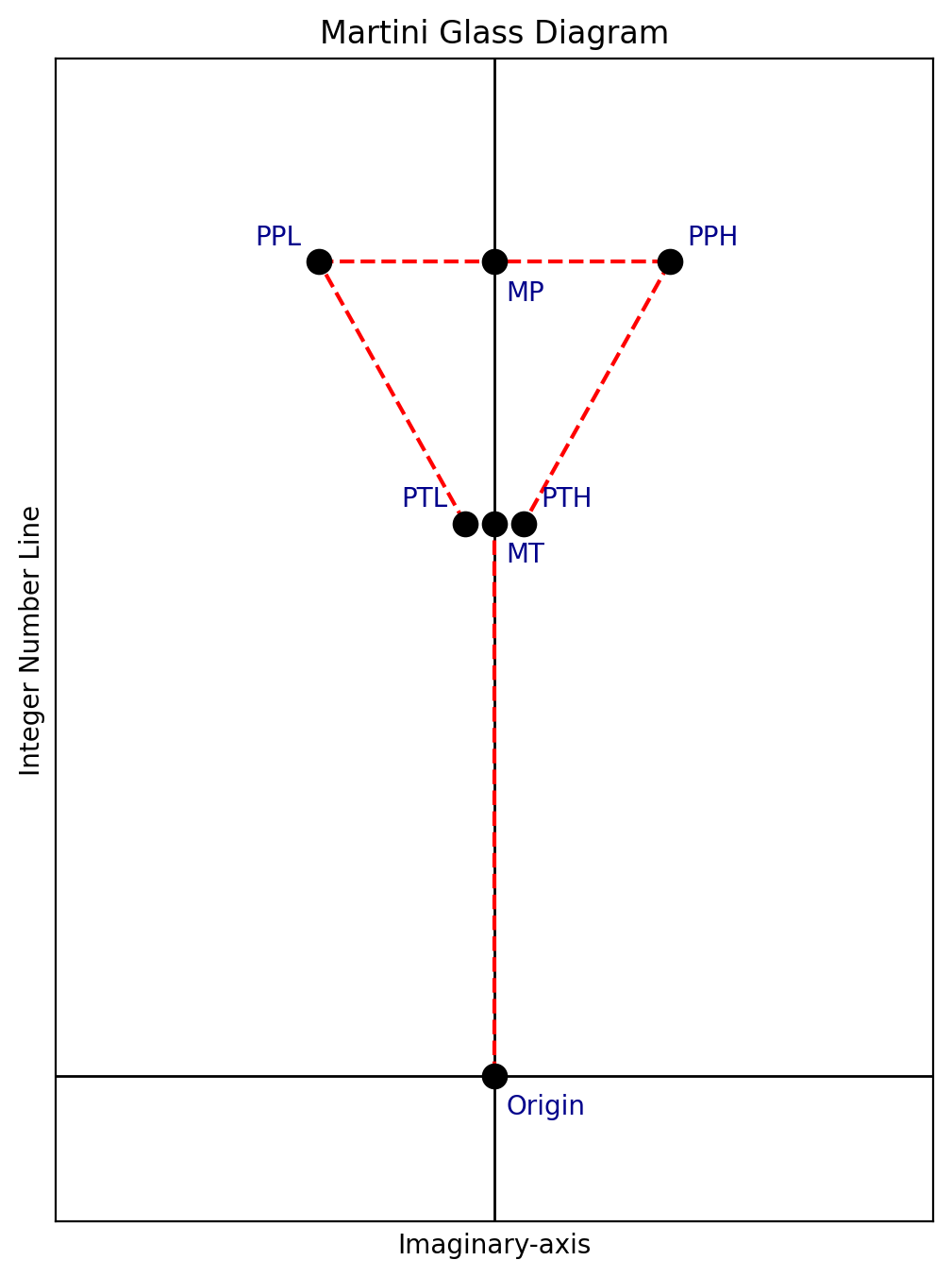
Martini Glass Diagram (Rotated)
Software Tools
Test the conjecture on your own machine. The tester has two modes: a streaming
consecutive mode that scales to 10⁸ and beyond, and an all-pairs mode
that checks every pair (both members greater than 3) up to a chosen bound. The all-pairs
mode also has an --include-3 switch that deliberately admits 3, reproducing
the boundary failures so you can see that they are exactly the 3-containing pairs.
Example runs:
py martini_conjecture_tester_v0_2.py consecutive --finish 100000000
py martini_conjecture_tester_v0_2.py all --bound 200000
py martini_conjecture_tester_v0_2.py all --bound 8000 --include-3
Where next
See the conjecture in action: the Martini Quartets page collects worked examples verified up to thousands of digits, and the Twin Primes page covers the midpoints the conjecture relies on. The Visualisations show these structures as fields. Part II will describe the reconstruction of the integer line from the principle of the conjecture.